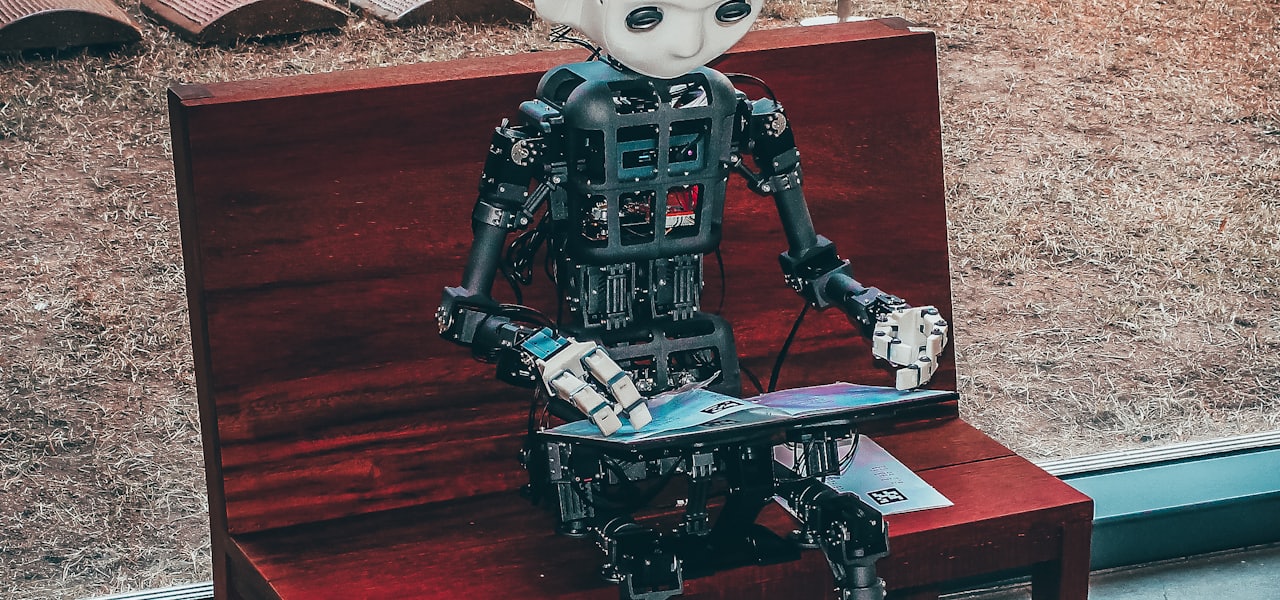
In artificial intelligence, an intelligent agent is an entity that perceives its environment, takes actions autonomously to achieve goals, and may improve its performance through machine learning or by acquiring knowledge. AI textbooks define artificial intelligence as the "study and design of intelligent agents," emphasizing that goal-directed behavior is central to intelligence. A specialized subset of intelligent agents, agentic AI (also known as an AI agent or simply agent), expands this concept by proactively pursuing goals, making decisions, and taking actions over extended periods. Intelligent agents can range from simple to highly complex. A basic thermostat or control system is considered an intelligent agent, as is a human being, or any other system that meets the same criteria—such as a firm, a state, or a biome. Intelligent agents operate based on an objective function, which encapsulates their goals. They are designed to create and execute plans that maximize the expected value of this function upon completion. For example, a reinforcement learning agent has a reward function, which allows programmers to shape its desired behavior. Similarly, an evolutionary algorithm's behavior is guided by a fitness function. Intelligent agents in artificial intelligence are closely related to agents in economics, and versions of the intelligent agent paradigm are studied in cognitive science, ethics, and the philosophy of practical reason, as well as in many interdisciplinary socio-cognitive modeling and computer social simulations. Intelligent agents are often described schematically as abstract functional systems similar to computer programs . To distinguish theoretical models from real-world implementations, abstract descriptions of intelligent agents are called abstract intelligent agents. Intelligent agents are also closely related to software agents—autonomous computer programs that carry out tasks on behalf of users. They are also referred to using a term borrowed from economics: a "rational agent". == Intelligent agents as the foundation of AI == The concept of intelligent agents provides a foundational lens through which to define and understand artificial intelligence. For instance, the influential textbook Artificial Intelligence: A Modern Approach (Russell & Norvig) describes: Agent: Anything that perceives its environment (using sensors) and acts upon it (using actuators). E.g., a robot with cameras and wheels, or a software program that reads data and makes recommendations. Rational Agent: An agent that strives to achieve the best possible outcome based on its knowledge and past experiences. "Best" is defined by a performance measure – a way of evaluating how well the agent is doing. Artificial Intelligence (as a field): The study and creation of these rational agents. Other researchers and definitions build upon this foundation. Padgham & Winikoff emphasize that intelligent agents should react to changes in their environment in a timely way, proactively pursue goals, and be flexible and robust (able to handle unexpected situations). Some also suggest that ideal agents should be "rational" in the economic sense (making optimal choices) and capable of complex reasoning, like having beliefs, desires, and intentions (BDI model). Kaplan and Haenlein offer a similar definition, focusing on a system's ability to understand external data, learn from that data, and use what is learned to achieve goals through flexible adaptation. Defining AI in terms of intelligent agents offers several key advantages: Avoids Philosophical Debates: It sidesteps arguments about whether AI is "truly" intelligent or conscious, like those raised by the Turing test or Searle's Chinese Room. It focuses on behavior and goal achievement, not on replicating human thought. Objective Testing: It provides a clear, scientific way to evaluate AI systems. Researchers can compare different approaches by measuring how well they maximize a specific "goal function" (or objective function). This allows for direct comparison and combination of techniques. Interdisciplinary Communication: It creates a common language for AI researchers to collaborate with other fields like mathematical optimization and economics, which also use concepts like "goals" and "rational agents." == Objective function == An objective function (or goal function) specifies the goals of an intelligent agent. An agent is deemed more intelligent if it consistently selects actions that yield outcomes better aligned with its objective function. In effect, the objective function serves as a measure of success. The objective function may be: Simple: For example, in a game of Go, the objective function might assign a value of 1 for a win and 0 for a loss. Complex: It might require the agent to evaluate and learn from past actions, adapting its behavior based on patterns that have proven effective. The objective function encapsulates all of the goals the agent is designed to achieve. For rational agents, it also incorporates the trade-offs between potentially conflicting goals. For instance, a self-driving car's objective function might balance factors such as safety, speed, and passenger comfort. Different terms are used to describe this concept, depending on the context. These include: Utility function: Often used in economics and decision theory, representing the desirability of a state. Objective function: A general term used in optimization. Loss function: Typically used in machine learning, where the goal is to minimize the loss (error). Reward Function: Used in reinforcement learning. Fitness Function: Used in evolutionary systems. Goals, and therefore the objective function, can be: Explicitly defined: Programmed directly into the agent. Induced: Learned or evolved over time. In reinforcement learning, a "reward function" provides feedback, encouraging desired behaviors and discouraging undesirable ones. The agent learns to maximize its cumulative reward. In evolutionary systems, a "fitness function" determines which agents are more likely to reproduce. This is analogous to natural selection, where organisms evolve to maximize their chances of survival and reproduction. Some AI systems, such as nearest-neighbor, reason by analogy rather than being explicitly goal-driven. However, even these systems can have goals implicitly defined within their training data. Such systems can still be benchmarked by framing the non-goal system as one whose "goal" is to accomplish its narrow classification task. Systems not traditionally considered agents, like knowledge-representation systems, are sometimes included in the paradigm by framing them as agents with a goal of, for example, answering questions accurately. Here, the concept of an "action" is extended to encompass the "act" of providing an answer. As a further extension, mimicry-driven systems can be framed as agents optimizing a "goal function" based on how closely the agent mimics the desired behavior. In generative adversarial networks (GANs) of the 2010s, an "encoder"/"generator" component attempts to mimic and improvise human text composition. The generator tries to maximize a function representing how well it can fool an antagonistic "predictor"/"discriminator" component. While symbolic AI systems often use an explicit goal function, the paradigm also applies to neural networks and evolutionary computing. Reinforcement learning can generate intelligent agents that appear to act in ways intended to maximize a "reward function". Sometimes, instead of setting the reward function directly equal to the desired benchmark evaluation function, machine learning programmers use reward shaping to initially give the machine rewards for incremental progress. Yann LeCun stated in 2018, "Most of the learning algorithms that people have come up with essentially consist of minimizing some objective function." AlphaZero chess had a simple objective function: +1 point for each win, and -1 point for each loss. A self-driving car's objective function would be more complex. Evolutionary computing can evolve intelligent agents that appear to act in ways intended to maximize a "fitness function" influencing how many descendants each agent is allowed to leave. The mathematical formalism of AIXI was proposed as a maximally intelligent agent in this paradigm. However, AIXI is uncomputable. In the real world, an intelligent agent is constrained by finite time and hardware resources, and scientists compete to produce algorithms that achieve progressively higher scores on benchmark tests with existing hardware. == Agent function == An intelligent agent's behavior can be described mathematically by an agent function. This function determines what the agent does based on what it has seen. A percept refers to the agent's sensory inputs at a single point in time. For example, a self-driving car's percepts might include camera images, lidar data, GPS coordinates, and speed r
DAVI
The Dutch Automated Vehicle Initiative (DAVI) is a research and demonstration initiative developing automated vehicles for use on public roads. The project is unique in that, besides simply making driverless cars, it also focuses on having automated vehicles share information among each other. The aim is to have the cars help to avoid traffic congestion by reducing the safety distance between the cars (from 2 seconds to 0.5 seconds) and avoiding sudden traffic slow-downs due to maneuvers undertaken by drivers.
Test data
Test data are sets of inputs or information used to verify the correctness, performance, and reliability of software systems. Test data encompass various types, such as positive and negative scenarios, edge cases, and realistic user scenarios, and aims to exercise different aspects of the software to uncover bugs and validate its behavior. Test data is also used in regression testing to verify that new code changes or enhancements do not introduce unintended side effects or break existing functionalities. == Background == Test data may be used to verify that a given set of inputs to a function produces an expected result. Alternatively, data can be used to challenge the program's ability to handle unusual, extreme, exceptional, or unexpected inputs. Test data can be produced in a focused or systematic manner, as is typically the case in domain testing, or through less focused approaches, such as high-volume randomized automated tests. Test data can be generated by the tester or by a program or function that assists the tester. It can be recorded for reuse or used only once. Test data may be created manually, using data generation tools (often based on randomness), or retrieved from an existing production environment. The data set may consist of synthetic (fake) data, but ideally, it should include representative (real) data. == Limitations == Due to privacy regulations such as GDPR, PCI, and the HIPAA, the use of privacy-sensitive personal data for testing is restricted. However, anonymized (and preferably subsetted) production data may be used as representative data for testing and development. Programmers may also choose to generate synthetic data as an alternative to using real or anonymized data. While synthetic data can offer significant advantages, such as enhanced privacy and flexibility, it also comes with limitations. For instance, generating synthetic data that accurately reflects real-world complexity can be challenging. There is also a risk of synthetic data not fully capturing the nuances of real data, potentially leading to gaps in test coverage. == Domain testing == Domain testing is a set of techniques focusing on test data. This includes identifying critical inputs, values at the boundaries between equivalence classes, and combinations of inputs that drive the system toward specific outputs. Domain testing helps ensure that various scenarios are effectively tested, including edge cases and unusual conditions.
Digital image correlation and tracking
Digital image correlation and tracking is an optical method that employs tracking and image registration techniques for accurate 2D and 3D measurements of changes in 2D images or 3D volumes. This method is often used to measure full-field displacement and strains, and it is widely applied in many areas of science and engineering. Compared to strain gauges and extensometers, digital image correlation methods provide finer details about deformation, due to the ability to provide both local and average data. == Overview == Digital image correlation (DIC) techniques have been increasing in popularity, especially in micro- and nano-scale mechanical testing applications due to their relative ease of implementation and use. Advances in computer technology and digital cameras have been the enabling technologies for this method and while white-light optics has been the predominant approach, DIC can be and has been extended to almost any imaging technology. The concept of using cross-correlation to measure shifts in datasets has been known for a long time, and it has been applied to digital images since at least the early 1970s. The present-day applications are almost innumerable, including image analysis, image compression, velocimetry, and strain estimation. Much early work in DIC in the field of mechanics was led by researchers at the University of South Carolina in the early 1980s and has been optimized and improved in recent years. Commonly, DIC relies on finding the maximum of the correlation array between pixel intensity array subsets on two or more corresponding images, which gives the integer translational shift between them. It is also possible to estimate shifts to a finer resolution than the resolution of the original images, which is often called "sub-pixel" registration because the measured shift is smaller than an integer pixel unit. For sub-pixel interpolation of the shift, other methods do not simply maximize the correlation coefficient. An iterative approach can also be used to maximize the interpolated correlation coefficient by using non-linear optimization techniques. The non-linear optimization approach tends to be conceptually simpler and can handle large deformations more accurately, but as with most nonlinear optimization techniques, it is slower. The two-dimensional discrete cross correlation r i j {\displaystyle r_{ij}} can be defined in several ways, one possibility being: r i j = ∑ m ∑ n [ f ( m + i , n + j ) − f ¯ ] [ g ( m , n ) − g ¯ ] ∑ m ∑ n [ f ( m , n ) − f ¯ ] 2 ∑ m ∑ n [ g ( m , n ) − g ¯ ] 2 . {\displaystyle r_{ij}={\frac {\sum _{m}\sum _{n}[f(m+i,n+j)-{\bar {f}}][g(m,n)-{\bar {g}}]}{\sqrt {\sum _{m}\sum _{n}{[f(m,n)-{\bar {f}}]^{2}}\sum _{m}\sum _{n}{[g(m,n)-{\bar {g}}]^{2}}}}}.} Here f(m, n) is the pixel intensity or the gray-scale value at a point (m, n) in the original image, g(m, n) is the gray-scale value at a point (m, n) in the translated image, f ¯ {\displaystyle {\bar {f}}} and g ¯ {\displaystyle {\bar {g}}} are mean values of the intensity matrices f and g respectively. However, in practical applications, the correlation array is usually computed using Fourier-transform methods, since the fast Fourier transform is a much faster method than directly computing the correlation. F = F { f } , G = F { g } . {\displaystyle \mathbf {F} ={\mathcal {F}}\{f\},\quad \mathbf {G} ={\mathcal {F}}\{g\}.} Then taking the complex conjugate of the second result and multiplying the Fourier transforms together elementwise, we obtain the Fourier transform of the correlogram, R {\displaystyle \ R} : R = F ∘ G ∗ , {\displaystyle R=\mathbf {F} \circ \mathbf {G} ^{},} where ∘ {\displaystyle \circ } is the Hadamard product (entry-wise product). It is also fairly common to normalize the magnitudes to unity at this point, which results in a variation called phase correlation. Then the cross-correlation is obtained by applying the inverse Fourier transform: r = F − 1 { R } . {\displaystyle \ r={\mathcal {F}}^{-1}\{R\}.} At this point, the coordinates of the maximum of r i j {\displaystyle r_{ij}} give the integer shift: ( Δ x , Δ y ) = arg max ( i , j ) { r } . {\displaystyle (\Delta x,\Delta y)=\arg \max _{(i,j)}\{r\}.} == Deformation mapping == For deformation mapping, the mapping function that relates the images can be derived from comparing a set of subwindow pairs over the whole images. (Figure 1). The coordinates or grid points (xi, yj) and (xi, yj) are related by the translations that occur between the two images. If the deformation is small and perpendicular to the optical axis of the camera, then the relation between (xi, yj) and (xi, yj) can be approximated by a 2D affine transformation such as: x ∗ = x + u + ∂ u ∂ x Δ x + ∂ u ∂ y Δ y , {\displaystyle x^{}=x+u+{\frac {\partial u}{\partial x}}\Delta x+{\frac {\partial u}{\partial y}}\Delta y,} y ∗ = y + v + ∂ v ∂ x Δ x + ∂ v ∂ y Δ y . {\displaystyle y^{}=y+v+{\frac {\partial v}{\partial x}}\Delta x+{\frac {\partial v}{\partial y}}\Delta y.} Here u and v are translations of the center of the sub-image in the X and Y directions respectively. The distances from the center of the sub-image to the point (x, y) are denoted by Δ x {\displaystyle \Delta x} and Δ y {\displaystyle \Delta y} . Thus, the correlation coefficient rij is a function of displacement components (u, v) and displacement gradients ∂ u ∂ x , ∂ u ∂ y , ∂ v ∂ x , ∂ v ∂ y . {\displaystyle {\frac {\partial u}{\partial x}},{\frac {\partial u}{\partial y}},{\frac {\partial v}{\partial x}},{\frac {\partial v}{\partial y}}.} DIC has proven to be very effective at mapping deformation in macroscopic mechanical testing, where the application of specular markers (e.g. paint, toner powder) or surface finishes from machining and polishing provide the needed contrast to correlate images well. However, these methods for applying surface contrast do not extend to the application of free-standing thin films for several reasons. First, vapor deposition at normal temperatures on semiconductor grade substrates results in mirror-finish quality films with RMS roughnesses that are typically on the order of several nanometers. No subsequent polishing or finishing steps are required, and unless electron imaging techniques are employed that can resolve microstructural features, the films do not possess enough useful surface contrast to adequately correlate images. Typically this challenge can be circumvented by applying paint that results in a random speckle pattern on the surface, although the large and turbulent forces resulting from either spraying or applying paint to the surface of a free-standing thin film are too high and would break the specimens. In addition, the sizes of individual paint particles are on the order of μms, while the film thickness is only several hundred nanometers, which would be analogous to supporting a large boulder on a thin sheet of paper. == Digital volume correlation == Digital Volume Correlation (DVC, and sometimes called Volumetric-DIC) extends the 2D-DIC algorithms into three dimensions to calculate the full-field 3D deformation from a pair of 3D images. This technique is distinct from 3D-DIC, which only calculates the 3D deformation of an exterior surface using conventional optical images. The DVC algorithm is able to track full-field displacement information in the form of voxels instead of pixels. The theory is similar to above except that another dimension is added: the z-dimension. The displacement is calculated from the correlation of 3D subsets of the reference and deformed volumetric images, which is analogous to the correlation of 2D subsets described above. DVC can be performed using volumetric image datasets. These images can be obtained using confocal microscopy, X-ray computed tomography, Magnetic Resonance Imaging or other techniques. Similar to the other DIC techniques, the images must exhibit a distinct, high-contrast 3D "speckle pattern" to ensure accurate displacement measurement. DVC was first developed in 1999 to study the deformation of trabecular bone using X-ray computed tomography images. Since then, applications of DVC have grown to include granular materials, metals, foams, composites and biological materials. To date it has been used with images acquired by MRI imaging, Computer Tomography (CT), micro-CT, confocal microscopy, and lightsheet microscopy. DVC is currently considered to be ideal in the research world for 3D quantification of local displacements, strains, and stress in biological specimens. It is preferred because of the non-invasiveness of the method over traditional experimental methods. Two of the key challenges are improving the speed and reliability of the DVC measurement. The 3D imaging techniques produce noisier images than conventional 2D optical images, which reduces the quality of the displacement measurement. Computational speed is restricted by the file sizes of 3D images, which are significantly larger than 2D images. For example, an
RCUDA
rCUDA, which stands for Remote CUDA, is a type of middleware software framework for remote GPU virtualization. Fully compatible with the CUDA application programming interface (API), it allows the allocation of one or more CUDA-enabled GPUs to a single application. Each GPU can be part of a cluster or running inside of a virtual machine. The approach is aimed at improving performance in GPU clusters that are lacking full utilization. GPU virtualization reduces the number of GPUs needed in a cluster, and in turn, leads to a lower cost configuration – less energy, acquisition, and maintenance. The recommended distributed acceleration architecture is a high performance computing cluster with GPUs attached to only a few of the cluster nodes. When a node without a local GPU executes an application needing GPU resources, remote execution of the kernel is supported by data and code transfers between local system memory and remote GPU memory. rCUDA is designed to accommodate this client-server architecture. On one end, clients employ a library of wrappers to the high-level CUDA Runtime API, and on the other end, there is a network listening service that receives requests on a TCP port. Several nodes running different GPU-accelerated applications can concurrently make use of the whole set of accelerators installed in the cluster. The client forwards the request to one of the servers, which accesses the GPU installed in that computer and executes the request in it. Time-multiplexing the GPU, or in other words sharing it, is accomplished by spawning different server processes for each remote GPU execution request. == rCUDA v20.07 == The rCUDA middleware enables the concurrent usage of CUDA-compatible devices remotely. rCUDA employs either the InfiniBand network or the socket API for the communication between clients and servers. rCUDA can be useful in three different environments: Clusters. To reduce the number of GPUs installed in High Performance Clusters. This leads to energy savings, as well as other related savings like acquisition costs, maintenance, space, cooling, etc. Academia. In commodity networks, to offer access to a few high performance GPUs concurrently to many students. Virtual Machines. To enable the access to the CUDA facilities on the physical machine. The current version of rCUDA (v20.07) supports CUDA version 9.0, excluding graphics interoperability. rCUDA v20.07 targets the Linux OS (for 64-bit architectures) on both client and server sides. CUDA applications do not need any change in their source code in order to be executed with rCUDA.
Corpus of Linguistic Acceptability
Corpus of Linguistic Acceptability (CoLA) is a dataset the primary purpose of which is to serve as a benchmark for evaluating the ability of artificial neural networks, including large language models, to judge the grammatical correctness of sentences. It consists of 10,657 English sentences from published linguistics literature that were manually labeled either as grammatical or ungrammatical. == Public version == The publicly available version of CoLA contains 9,594 sentences that belong to training and development sets. It excludes 1,063 sentences reserved for a held-out test set.
Django (web framework)
Django ( JANG-goh; sometimes stylized as django) is a free and open-source, Python-based web framework that runs on a web server. It follows the model–template–views (MTV) architectural pattern. It is maintained by the Django Software Foundation (DSF), an independent organization established in the US as a 501(c)(3) non-profit. Django's primary goal is to ease the creation of complex, database-driven websites. The framework emphasizes reusability and "pluggability" of components, less code, low coupling, rapid development, and the principle of don't repeat yourself. Python is used throughout, even for settings, files, and data models. Django also provides an optional administrative create, read, update and delete interface that is generated dynamically through introspection and configured via admin models. Some well-known sites that use Django include Instagram, Mozilla, Disqus, Bitbucket, Nextdoor, and Clubhouse. == History == Django was created in the autumn of 2003, when the web programmers at the Lawrence Journal-World newspaper, Adrian Holovaty and Simon Willison, began using Python to build applications. Jacob Kaplan-Moss was hired early in Django's development shortly before Willison's internship ended. It was released publicly under a BSD license in July 2005. The framework was named after guitarist Django Reinhardt. Holovaty is a romani jazz guitar player inspired in part by Reinhardt's music. In June 2008, it was announced that a newly formed Django Software Foundation (DSF) would maintain Django in the future. == Features == === Components === Despite having its own nomenclature, such as naming the callable objects generating the HTTP responses "views", the core Django framework can be seen as an MVC architecture. It consists of an object-relational mapper (ORM) that mediates between data models (defined as Python classes) and a relational database ("Model"), a system for processing HTTP requests with a web templating system ("View"), and a regular-expression-based URL dispatcher ("Controller"). Also included in the core framework are: a lightweight and standalone web server for development and testing a form serialization and validation system that can translate between HTML forms and values suitable for storage in the database a template system that utilizes the concept of inheritance borrowed from object-oriented programming a caching framework that can use any of several cache methods support for middleware classes that can intervene at various stages of request processing and carry out custom functions an internal dispatcher system that allows components of an application to communicate events to each other via pre-defined signals an internationalization system, including translations of Django's own components into a variety of languages a serialization system that can produce and read XML and/or JSON representations of Django model instances a system for extending the capabilities of the template engine an interface to Python's built-in unit test framework === Bundled applications === The main Django distribution also bundles a number of applications in its "contrib" package, including: an extensible authentication system the dynamic administrative interface tools for generating RSS and Atom syndication feeds a "Sites" framework that allows one Django installation to run multiple websites, each with their own content and applications tools for generating Sitemaps built-in mitigation for cross-site request forgery, cross-site scripting, SQL injection, password cracking and other typical web attacks, most of them turned on by default a framework for creating geographic information system (GIS) applications === Extensibility === Django's configuration system allows third-party code to be plugged into a regular project, provided that it follows the reusable app conventions. More than 5000 packages are available to extend the framework's original behavior, providing solutions to issues the original tool didn't tackle: registration, search, API provision and consumption, CMS, etc. This extensibility is, however, mitigated by internal components' dependencies. While the Django philosophy implies loose coupling, the template filters and tags assume one engine implementation, and both the auth and admin bundled applications require the use of the internal ORM. None of these filters or bundled apps are mandatory to run a Django project, but reusable apps tend to depend on them, encouraging developers to keep using the official stack in order to benefit fully from the apps ecosystem. === Server arrangements === Django can be run on ASGI or WSGI-compliant web servers. Django officially supports five database backends: PostgreSQL, MySQL, MariaDB, SQLite, and Oracle. Microsoft SQL Server can be used with mssql-django. == Version history == The Django team will occasionally designate certain releases to be "long-term support" (LTS) releases. LTS releases will get security and data loss fixes applied for a guaranteed period of time, typically 3+ years, regardless of the pace of releases afterwards. == Community == === DjangoCon === There is a semiannual conference for Django developers and users, named "DjangoCon", that has been held since September 2008. DjangoCon is held annually in Europe, in May or June; while another is held in the United States in August or September, in various cities. ==== United States ==== The 2012 DjangoCon took place in Washington, D.C., from September 3 to 8. 2013 DjangoCon was held in Chicago at the Hyatt Regency Hotel and the post-conference Sprints were hosted at Digital Bootcamp, computer training center. The 2014 DjangoCon US returned to Portland, OR from August 30 to 6 September. The 2015 DjangoCon US was held in Austin, TX from September 6 to 11 at the AT&T Executive Center. The 2016 DjangoCon US was held in Philadelphia, PA at The Wharton School of the University of Pennsylvania from July 17 to 22. The 2017 DjangoCon US was held in Spokane, WA; in 2018 DjangoCon US was held in San Diego, CA. DjangoCon US 2019 was held again in San Diego, CA from September 22 to 27. DjangoCon 2021 took place virtually and in 2022, DjangoCon US returned to San Diego from October 16 to 21. DjangoCon US 2023 was held from October 16 to 20 at the Durham, NC convention center and DjangoCon US 2024 took place also in Durham in September 22 to 27. DjangoCon US 2025 was held from September 8 to 12 in Chicago, Illinois. ==== Europe ==== The 2025 edition of DjangoCon Europe took place in Dublin, Ireland from 23 to 27 April. In 2024, the conference was hosted in Vigo, Spain. Edinburgh, Scotland served as the venue for DjangoCon Europe in 2023. The 2022 conference was organized in Porto, Portugal. In 2021, DjangoCon Europe was held virtually due to the COVID-19 pandemic. The 2020 edition was also conducted as a fully virtual event. DjangoCon Europe 2019 was held in Copenhagen, Denmark. In 2018, the event took place in Heidelberg, Germany. The 2017 conference was convened in Florence, Italy. DjangoCon Europe 2012 was organized in Zurich, Switzerland. ==== Australia ==== Django mini-conferences are usually held every year as part of the Australian Python Conference 'PyCon AU'. Previously, these mini-conferences have been held in: Hobart, Australia, in July 2013, Brisbane, Australia, in August 2014 and 2015, Melbourne, Australia in August 2016 and 2017, and Sydney, Australia, in August 2018 and 2019. ==== Africa ==== The first DjangoCon Africa was held in Zanzibar, Tanzania, from 6 to 11 November 2023. The event hosted approximately 200 attendees from 22 countries, including 103 women. The conference featured 26 talks on topics such as software development, education, careers, accessibility, and agriculture, often highlighting perspectives from across the African continent. Future editions of the conference are planned, with details available on the official website === Community groups & programs === Django has spawned user groups and meetups around the world, a notable group is the Django Girls organization, which began in Poland but now has had events in 91 countries. Another initiative is Djangonaut Space, a mentorship program aimed at supporting new contributors to the Django ecosystem. The program pairs experienced mentors with developers to guide them through making meaningful contributions to Django and its community. It emphasizes long-term engagement, inclusion, and collaborative open-source development. == Ports to other languages == Programmers have ported Django's template engine design from Python to other languages, providing decent cross-platform support. Some of these options are more direct ports; others, though inspired by Django and retaining its concepts, take the liberty to deviate from Django's design: Liquid for Ruby Template::Swig for Perl Twig for PHP and JavaScript Jinja for Python ErlyDTL for Erlang == CMSs based on Django Framework == Django as a framework is capable of building a complete CMS